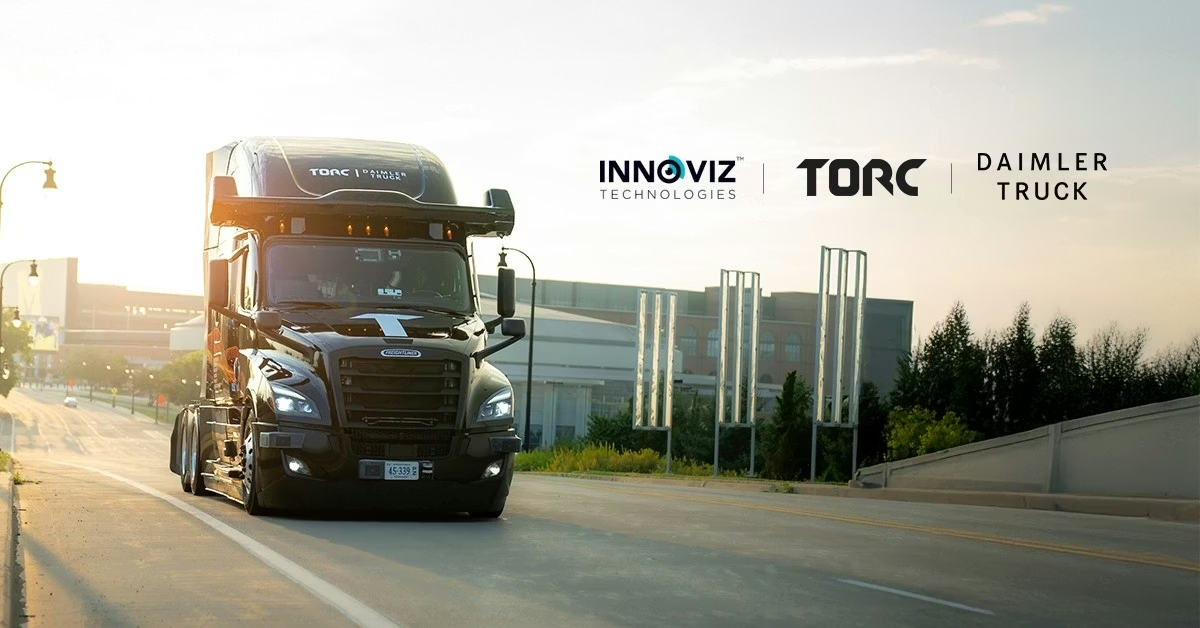
The December 2025 announcement that Innoviz will supply InnovizTwo Short-Range LiDAR sensors for Daimler’s next-generation semi-trucks is more than a typical supply agreement. It signals a significant move toward scalable, practical autonomy on North American highways, bringing industry goals closer to realization.
For decades, trucking has been both essential and challenging for supply-chain logistics, remaining physically demanding, costly, and hazardous. Autonomous trucks aim to reduce human error, lower costs, and improve efficiency. However, deployment has been slow due to the difficulty of developing sensors and perception systems that perform reliably in all conditions, including adverse weather, nighttime, heavy traffic, and unpredictable scenarios.
LiDAR, or laser-based “light detection and ranging,” generates precise 3-D maps of vehicles, pedestrians, obstacles, and infrastructure, exceeding human vision and reflexes. Daimler and Torc’s selection of Innoviz reflects a consensus that reliable autonomy requires LiDAR as a core sensor rather than an optional addition.
Key implications of this agreement and considerations moving forward
- Autonomous technology is moving from pilot projects to production-ready systems. This is not a one-time research contract. Daimler and Torc plan series production for L4 Class-8 semi-trucks, meaning the hardware will be manufactured for broad commercial deployment, not just test fleets. PR Newswire+2Investing.com+2
- Safety and reliability are now essential. Innoviz claims its sensors are “automotive-grade” and built for “the most challenging conditions.” PR Newswire+2Innoviz Technologies Ltd.+2 This suggests LiDAR — with its advantages in depth perception and obstacle detection — is central to the autonomous stack.
- The path forward is complex. LiDAR is one component among radar, cameras, software, and redundant safety systems, all of which must operate together. Daimler and Torc describe LiDAR as a “virtual driver” supported by backup systems. Markets, infrastructure, regulation, and adoption by drivers or fleet owners remain significant challenges for Torc Robotics.
The increasing importance of timing
Global supply-chain strains, driver shortages, volatile fuel prices, and rising labor costs push logistics toward innovation. Autonomous trucks offer lower operating costs and, crucially, a safer road environment for all vehicles.
Public trust in automation remains fragile. Any incident involving autonomous trucks could hinder progress. Daimler and Torc’s use of proven LiDAR sensors demonstrates a commitment to comprehensive, reliable sensor suites, prioritizing safety over expedience.
An established truck manufacturer’s decision to scale LiDAR-based autonomy could accelerate regulatory acceptance. If Daimler’s trucks demonstrate safe performance in real-world conditions, insurers, regulators, and customers may begin to view autonomous freight as mainstream rather than experimental.
However, it is important not to mistake possibility for inevitability.
Yes, this partnership is a milestone. Yes, LiDAR-based autonomy has matured. But we must be realistic about upcoming challenges:
- Mixed-traffic environments, where trucks share lanes with human drivers, cyclists, and pedestrians, will require advanced handling of edge cases such as weather, debris, and unpredictable behavior, which no technology can fully guarantee.
- Infrastructure and logistics will face significant changes. Fleets must adapt operations, maintenance, and business models, while loading docks, rest stops, fueling, charging, and legal frameworks may all need to be reconsidered.
- The workforce will be affected as driverless trucks could reshape trucking jobs, impacting livelihoods and supply-chain labor. This transition requires social planning in addition to technical implementation.
Conclusion: A landmark step, but part of a longer journey
The Innoviz, Daimler Truck, and Torc Robotics agreement shows that, by 2025, autonomous trucking is moving from aspiration to reality, built with real hardware for production. This marks a turning point for logistics and a cautious step forward for road safety.
However, this promise brings significant responsibilities, including rigorous safety validation, transparent regulation, and thoughtful social adaptation. Success could initiate safer, more efficient freight transport, while failure risks undermining public trust.