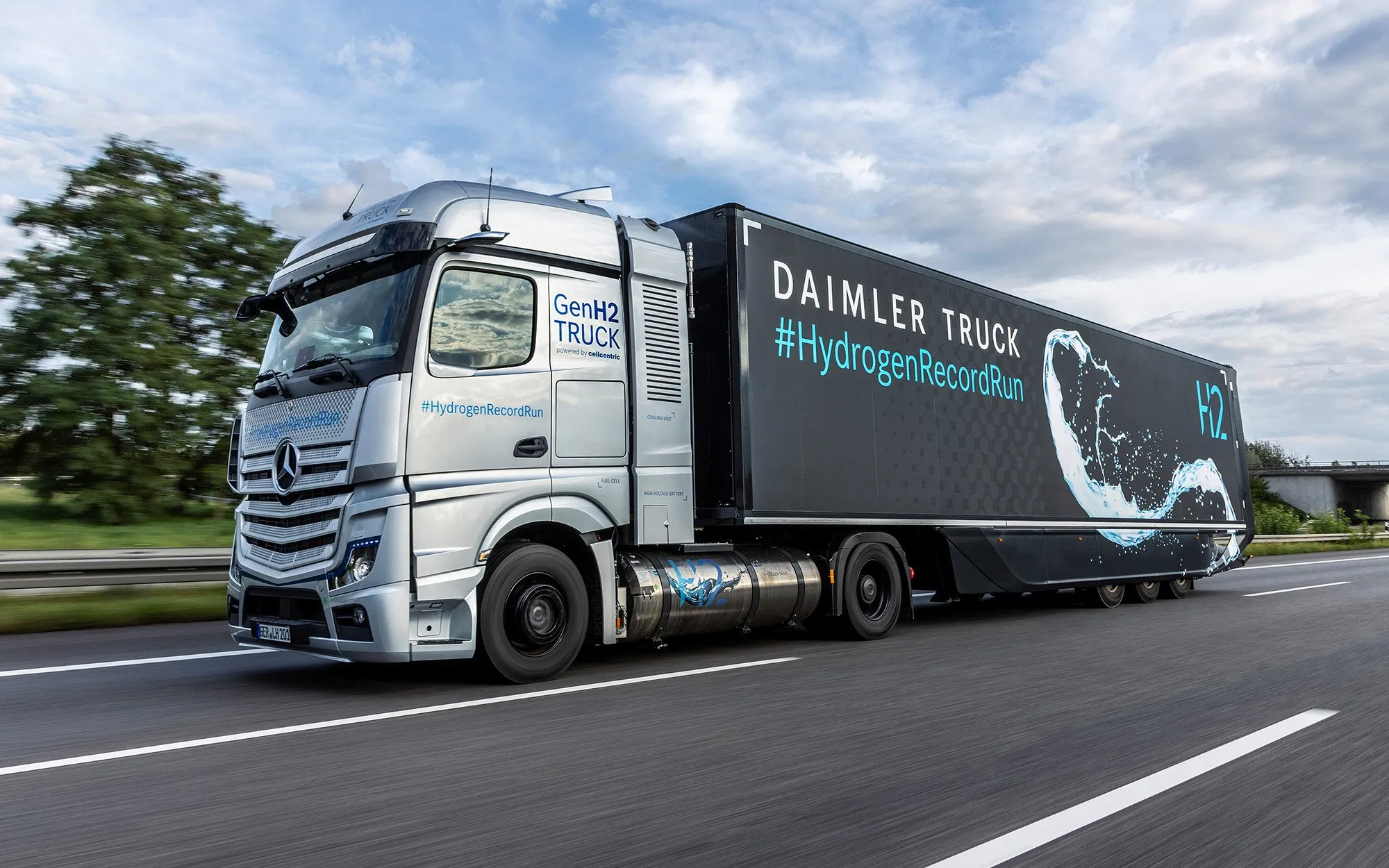
The unveiling of the Mercedes-Benz NextGenH2 Truck by Daimler Truck is less about a single vehicle launch and more about knowledge transfer—showing how hydrogen fuel-cell technology is moving from concept and pilot testing toward early commercialization in heavy-duty freight.
With a small-series rollout planned for 2026, Daimler is clearly positioning the NextGenH2 as a learning bridge between today’s diesel operations and a future zero-emission long-haul ecosystem.
Why Hydrogen Matters in Long-Haul Trucking
Battery-electric trucks are proving effective for regional and depot-based operations. However, long-haul freight introduces constraints around range, payload, and downtime. Hydrogen fuel cells address these gaps by separating energy storage (hydrogen) from energy conversion (fuel cells).
The NextGenH2 uses liquid hydrogen (LH₂) rather than compressed gas. From a systems perspective, this matters because liquid hydrogen has a higher energy density, enabling:
- Operating ranges well beyond 1,000 km
- Refuelling times measured in minutes rather than hours
- Payload parity closer to diesel configurations
This makes hydrogen particularly relevant for corridors where vehicles must stay in near-continuous motion.
Technology Stack: Translating Prototypes into Production Logic
The NextGenH2 builds on lessons learned from earlier GenH2 demonstrators, but with a stronger focus on production feasibility and operational integration.
Key elements include:
- Dual fuel-cell system (300 kW total output)
Designed to support sustained highway speeds under full load rather than short-duty cycles. - High-capacity liquid hydrogen storage (~85 kg)
Enables long-range missions without mid-route refuelling dependencies. - Buffer battery (LFP chemistry)
Used for regenerative braking, load balancing, and transient power demands—an architecture increasingly common across zero-emission platforms. - Shared components with battery-electric trucks
Daimler intentionally reused elements from the eActros 600, including the cab, e-axle architecture, and digital cockpit. This reduces system complexity and accelerates service readiness.
From a knowledge-transfer standpoint, this shows how OEMs are converging electric and hydrogen platforms rather than developing them in isolation.
Operational Considerations Beyond the Powertrain
Daimler also addressed practical issues that often get overlooked in early hydrogen discussions:
- Boil-off management allows indoor parking and overnight cab stays
- Shorter wheelbase configurations improve trailer compatibility
- Integrated safety and leak detection systems reflect regulatory and fleet-operator requirements
These design choices indicate that the NextGenH2 is being evaluated not just as a technology demonstrator, but as a truck intended to fit into existing logistics workflows.
Small-Series Production: Why 2026 Is Important
The planned small-series build (approximately 100 units) starting in late 2026 is a critical step. This phase is less about volume and more about data collection:
- Real-world durability
- Fleet maintenance patterns
- Hydrogen consumption under varied duty cycles
- Driver acceptance and operational behavior
The program is supported by significant public funding in Germany, highlighting how government and industry are jointly de-risking early hydrogen deployments.
Full-scale production is expected in the early 2030s, aligning with anticipated growth in hydrogen refuelling infrastructure and green hydrogen supply.
What This Signals for the Industry
The NextGenH2 does not suggest that hydrogen will replace battery-electric or diesel overnight. Instead, it reinforces a multi-technology future for freight:
- Battery-electric for short and regional haul
- Hydrogen fuel cell for long-distance, high-utilization routes
- Shared electric architectures underneath both
For fleets, policymakers, and infrastructure planners, the key takeaway is not just the truck itself, but the system thinking behind it—how powertrain choice, infrastructure readiness, and operational realities must align.
Closing Perspective
The Mercedes-Benz Trucks NextGenH2 is best understood as an educational milestone. It demonstrates how hydrogen trucking is transitioning from experimentation to structured deployment, with clear assumptions, measured risk, and defined learning objectives.
As the industry moves toward decarbonization, this kind of transparent, step-by-step evolution is what turns emerging technology into operational reality.