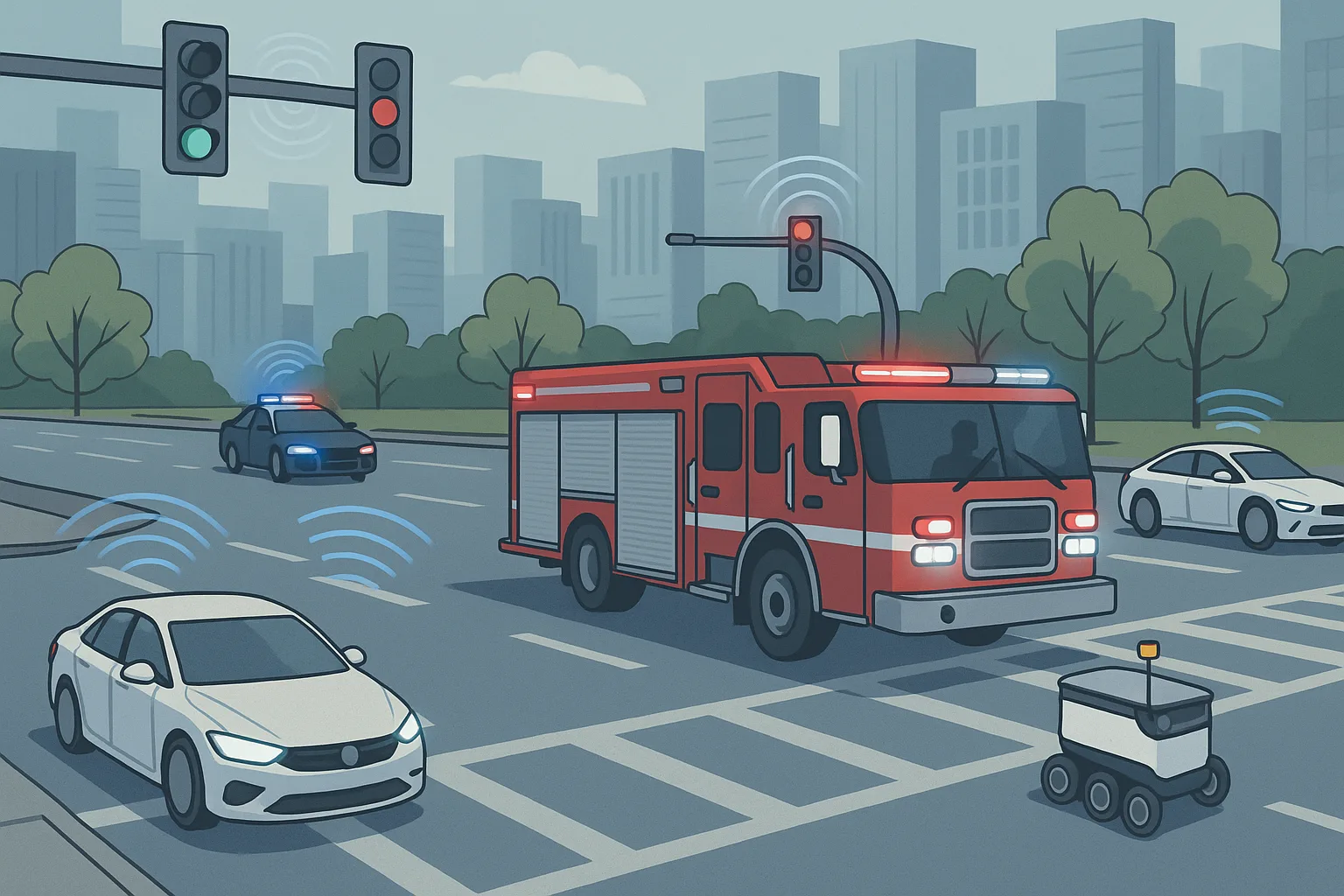
Every second is vital for emergency responders, yet traffic signals and inattentive drivers often cause delays. Vehicle-to-everything (V2X) technology, such as Kapsch TrafficCom’s solutions, connects emergency vehicles with traffic signals and other road users in real time. This coordination clears routes, alerts drivers, and integrates autonomous vehicles, resulting in faster response times and enhanced safety. The following sections review Kapsch V2X deployments and the need to expand this infrastructure for emergency mobility.
Emergency Vehicle Signal Preemption: Green Lights for Faster Response
Red lights delay emergency vehicles and increase the risk of collisions when navigating stopped traffic. V2X-enabled emergency vehicle preemption addresses this by allowing an on-board unit (OBU) in the vehicle to communicate with roadside units (RSUs) at intersections. As the vehicle approaches, the system turns the traffic light green, clearing a safe path and allowing responders to proceed without delay.
Real-world deployments demonstrate the effectiveness of this technology. In Greeley, Colorado, a Kapsch-led pilot is equipping 45 intersections with connected RSUs and installing OBUs in 50 city emergency vehicles and snowplows (itsinternational.com). The system “reacts to approaching emergency vehicles and automatically adapts traffic lights so that the vehicle can pass the intersection without endangering itself and other road users” (itsinternational.com). According to Greeley’s Public Works director, this USDOT-funded pilot will “help improve response times for emergency vehicles and snowplows” as part of the city’s Vision Zero safety initiative (itsinternational.com). In Calgary, Alberta, a similar Kapsch V2X deployment installed RSUs at 12 downtown intersections and OBUs in 10 fire vehicles (businesswire.com). When an emergency vehicle’s siren is activated, all lights ahead turn green, allowing the vehicle to proceed through cleared intersections and save critical time. These systems are managed through Kapsch’s Connected Mobility Control Center software, which enables traffic operators to centrally monitor and configure intersections. V2X preemption technology enables first responders to maintain uninterrupted passage through city streets, significantly reducing response times.
Broadcasting Presence: Alerting Drivers and Connected Vehicles to Yield
Clearing intersections is only part of the solution; alerting other drivers is equally important. Even with lights and sirens, emergency vehicles can still surprise motorists, especially in noisy or congested areas. V2X technology allows emergency vehicles to broadcast their presence to nearby connected vehicles and devices. When an ambulance or fire engine is within range, it sends electronic alerts to approaching cars, connected traffic signs, or smartphone apps, providing location and direction. This gives drivers more time to yield safely and clear the lane before the siren is audible, and helps prevent sudden braking or confusion as connected vehicles can respond smoothly.
Industry implementations highlight significant safety improvements. For example, Commsignia, a V2X technology provider, notes that V2X serves as a safety beacon, allowing emergency vehicles to “directly send alerts to all vehicles nearby,” providing advanced warning to yield. When drivers or onboard AI in autonomous vehicles are aware of an approaching ambulance, they can respond in a coordinated manner rather than making last-minute maneuvers. This connected awareness greatly reduces the risk of crashes during emergency responses. Studies indicate that modern preemption systems can reduce collisions involving emergency vehicles by up to 70% (appinfoinc.com). By broadcasting the emergency vehicle’s presence and trajectory, V2X enables safer and more orderly clearing of the way, protecting responders, patients, and all road users. When every connected vehicle and smart traffic sign is effectively “looking out” for sirens, overall safety improves.
Integration with Robo-Taxis and Delivery Bots: Coordinating Autonomous Traffic
V2X is essential for autonomous vehicles to operate safely alongside emergency responders. Robo-taxis, self-driving delivery pods, and autonomous buses must navigate around emergency scenes and vehicles. While autonomous vehicles have sensors, these can struggle to detect sirens or lights when the line of sight is blocked. V2X integration provides a direct digital link, allowing AVs to receive real-time emergency signals and traffic control commands in advance.
Kapsch’s work in Málaga, Spain, demonstrates this integration. In Málaga’s port area, an EU-backed pilot connected intelligent traffic lights with a driverless shuttle bus using V2X communication. Kapsch installed smart traffic controllers that transmit signal phase and timing (SPaT) data directly to the autonomous bus for each lane as it approaches an intersection. The bus “knows” the exact status of the traffic light and how long it will be until it changes, allowing it to adjust its speed or stop as needed in advance. This makes the shuttle’s journey smoother and safer, even through complex junctions that would challenge onboard sensors. This approach prevents accidents and keeps the shuttle running efficiently.
The same V2X infrastructure can prioritize and coordinate multiple vehicle types at once. The EcoTrafiX™ traffic control platform can set priorities for public transport, emergency vehicles, cyclists, or pedestrians as needed. In future cities, connected signals could pause an autonomous delivery robot at a crosswalk when a fire truck is approaching or instruct robo-taxis to reroute around emergencies. Companies testing self-driving cars are already using V2X inputs to ensure vehicles yield predictably to emergency vehicles. As these systems expand, autonomous vehicles will respond to the same preemption signals as traffic lights, ensuring robo-taxis yield to ambulances even without human drivers. This coordination is essential to prevent gridlock and maintain safe, efficient mobility.
Quantifiable Time Savings and Safety Impact
These innovations lead to faster emergency responses and fewer crashes, as shown by data from connected vehicle programs. In emergency response, saving seconds can save lives. By reducing stops and conflicts at intersections, V2X preemption significantly decreases response times. Nationwide studies show emergency response times drop by 15% to 50% with modern signal preemption, depending on traffic conditions (appinfoinc.com). In San Jose, CA, a GPS-based EVP system reduced intersection delays for fire units from about 7 seconds to under 1 second per junction on average (fhwa.dot.gov), saving about 30 seconds per response. These time savings can be critical for containing fires or providing life-saving treatment, directly impacting property and lives.
Safety improvements are also substantial. By clearing intersections and warning drivers early, connected preemption greatly reduces the risk of severe collisions, such as an ambulance striking a vehicle that did not see it coming. After San Jose’s system upgrade, fire department vehicle crashes dropped by more than 50% over five years (fhwa.dot.gov). Broader research shows that emergency vehicles using connected preemption systems can experience up to 70% fewer crashes than with traditional methods (appinfoinc.com). This results in fewer injuries to first responders and civilians, and less property damage. Pedestrians and cyclists also benefit: nearly 28% of emergency-vehicle-related pedestrian fatalities occur with lights and sirens on (commsignia.com), showing that traditional warnings do not always reach everyone. V2X addresses this by electronically extending the emergency vehicle’s visibility to all nearby road users, including those who may not see or hear the siren immediately.
To summarize the benefits seen so far, connected emergency vehicle technology has delivered:
- Faster Response Times: 15–50% reductions in run times reported, including city trials where intersection delays dropped to under 1 second. Every minute saved can increase survival odds or significantly reduce fire damage. The tech is in place, making responders and the public much safer during urgent runs.
- More Efficient Coordination: Traffic flows more smoothly around incidents, with less confusion at intersections. Additional benefits include fuel savings and reduced stress for drivers and responders.
These measurable gains show why cities are investing in connected mobility for emergency services. In emergency response, time saved translates directly to lives saved, and V2X is demonstrating significant impact in both areas.
Real-World Deployments Leading the Way
These benefits are not just theoretical; they are being realized in live deployments worldwide. Examples include Greeley’s USDOT-funded pilot in Colorado, Calgary’s downtown green-light project, and Málaga’s autonomous bus integration. Additional cities in Europe and the Middle East are also implementing V2X for emergency use. For example, Sharjah (UAE) is deploying a smart traffic management system with a C-ITS priority network, connecting 70 intersections and equipping emergency and transit vehicles to improve response in a growing city. Many municipalities are prioritizing emergency vehicles as they expand connected vehicle corridors and upgrade traffic signals. The technology is modular and scalable, allowing cities to start with critical junctions and expand coverage over time. Each new connected intersection enhances safety and efficiency for public safety teams.
These deployments often align with broader Vision Zero and smart city initiatives. For example, Greeley’s project is part of the US Department of Transportation’s Saving Lives with Connectivity program and the national connected vehicle deployment plan. The objective is not isolated technology demonstrations, but a coordinated effort to reduce traffic fatalities and improve incident response nationwide through connectivity. Each successful pilot builds confidence, advances the technology, and lowers costs for future implementations.
The Road Ahead: Connected Mobility for Safer Emergency Response
Looking ahead, expanding V2X infrastructure is essential for the future of connected emergency mobility. As more intersections, vehicles, and personal devices gain communication capabilities, the benefits will increase. We envision a near future where every emergency vehicle is connected and can signal along its entire route, every car receives an automatic alert to yield to approaching ambulances, and autonomous vehicles seamlessly pause or reroute for responders. In this future, ambulances stuck in traffic or collisions en route to the ER could become a thing of the past.
To achieve this, cities and agencies must continue investing in smart infrastructure and establish common standards to ensure interoperability across regions and vendors. Public-private collaboration is essential: agencies provide the mission and right-of-way, while technology providers like Kapsch contribute deployment and management expertise. Momentum is growing, with funding programs in the U.S., Canada, and the EU supporting connected vehicle pilots. Automotive manufacturers are also beginning to include V2X capabilities in new models, expanding the reach of emergency vehicle broadcasts.
In summary, Kapsch’s V2X technology and similar solutions are creating a safer, faster emergency response system. Real-world trials in Colorado, Calgary, Málaga, and other locations show that connected mobility is already delivering results. Fire departments are reaching scenes more quickly, EMTs face fewer traffic delays, and autonomous shuttles are navigating smart intersections alongside emergency crews. The next step is to scale these successes city by city. Each new connected intersection or vehicle strengthens the life-saving network. The future of emergency response is connected, cooperative, and highly efficient. By adopting V2X infrastructure now, cities can ensure emergency vehicles receive priority, help arrives faster, and streets become safer for everyone. The technology is available; the focus now is on widespread implementation to save lives.